

When the Center of Your Vision Starts to Change
Maybe words on a page aren’t as crisp as they used to be. Straight lines look slightly wavy. Faces are becoming harder to recognize, or you need brighter light to see details clearly.
Changes like these shouldn’t be ignored.
Age-related macular degeneration (AMD) affects the part of your vision you rely on for reading, driving, recognizing faces, and seeing fine details. While AMD can lead to vision loss, early detection and careful monitoring can help protect your sight and identify when treatment may be needed.
At Holmdel Eye Center, Dr. Ahmed Abdelhady provides comprehensive evaluation and ongoing care for patients with macular degeneration.
What Is Macular Degeneration?
Age-related macular degeneration affects the macula, the small central portion of the retina responsible for sharp, detailed vision.
Your peripheral—or side—vision usually remains intact, but changes to the macula can make the center of what you’re looking at appear blurry, distorted, or less detailed.
AMD becomes more common with age and can progress differently from one person to another.
Some people experience very gradual changes over many years. Others may develop more noticeable changes in their central vision.
Understanding which type of macular degeneration you have is an important first step in knowing what to expect.
Dry vs. Wet Macular Degeneration
There are two primary forms of age-related macular degeneration.
Dry Macular Degeneration
Dry AMD is the more common form.
It occurs as the macula gradually becomes thinner with age and small deposits called drusen accumulate beneath the retina.
Early dry AMD may cause few noticeable symptoms. As the condition progresses, you may begin to experience blurred central vision, difficulty seeing in low light, or trouble distinguishing fine details.
There is currently no treatment that reverses dry AMD, but regular monitoring is important. Certain patients may also benefit from specific nutritional supplements based on the stage of their disease.
Wet Macular Degeneration
Wet AMD is less common but can cause more rapid and significant changes in vision.
It develops when abnormal blood vessels grow beneath the retina and leak blood or fluid into the macula.
Unlike dry AMD, wet AMD often requires prompt treatment to help slow additional vision loss.
If you notice a sudden change in your central vision or straight lines suddenly appear wavy or distorted, contact an eye care provider promptly.
What Does Macular Degeneration Look Like?
Macular degeneration doesn’t usually cause complete blindness. Instead, it primarily affects central vision.
You may notice:
- Blurry or fuzzy vision in the center of what you’re looking at
- Straight lines that appear bent or wavy
- Difficulty reading small print
- Trouble recognizing faces
- A dim or blank area in your central vision
- Colors that appear less bright
- Needing more light to read or perform close-up tasks
- Difficulty adjusting when moving from bright to dim lighting
Early AMD may not cause noticeable symptoms at all, which is why routine dilated eye examinations become increasingly important as you get older.
Who Is at Risk for Macular Degeneration?
Age is the strongest risk factor for AMD, but it isn’t the only one.
Your risk may be higher if you:
- Are over age 50
- Have a family history of macular degeneration
- Smoke or have a history of smoking
- Have cardiovascular disease or high blood pressure
- Have high cholesterol
- Are overweight or have other cardiovascular risk factors
You can’t change your age or genetics, but understanding your risk gives you an opportunity to be proactive about monitoring your eyes and making healthy lifestyle choices.
How Is Macular Degeneration Diagnosed?
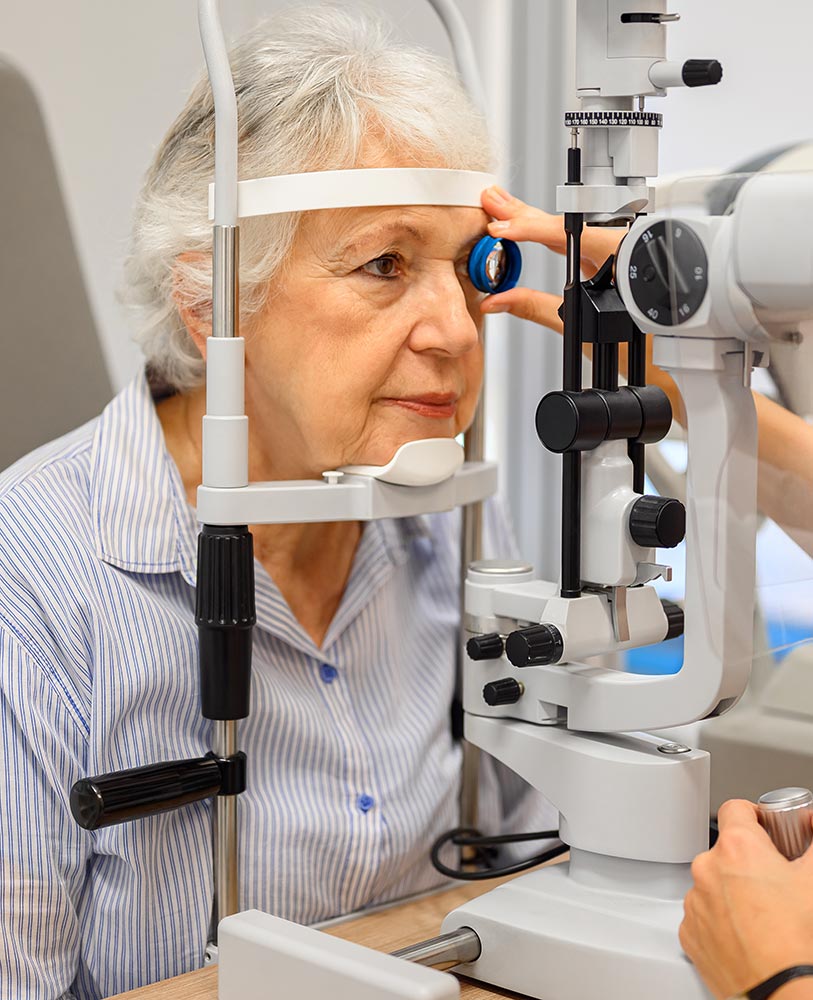
A comprehensive dilated eye examination allows Dr. Abdelhady to examine the macula and retina for signs of AMD.
Your evaluation may also include specialized retinal imaging that provides a detailed look at the layers of the retina and can identify changes that aren’t visible to you yet.
If you’ve already been diagnosed with AMD, these tests can also help monitor the condition over time.
That ongoing comparison is important.
Rather than simply looking at how your eyes appear today, Dr. Abdelhady can watch for subtle changes that may indicate your AMD is progressing.

Monitoring Your Vision at Home
If you have macular degeneration, you may be asked to monitor your central vision between appointments.
One common tool is an Amsler grid, a simple grid of straight lines with a dot in the center.
When looking at the grid one eye at a time, changes such as wavy, missing, blurry, or distorted lines may indicate a change in the macula.
Home monitoring doesn’t replace regular eye examinations, but it can help you recognize a new change sooner.
If something suddenly looks different, don’t wait until your next scheduled appointment to mention it.
Can Macular Degeneration Be Treated?
Treatment depends on the type and stage of AMD.
Managing Dry AMD
For dry AMD, care generally focuses on monitoring the retina and reducing modifiable risk factors.
For certain stages of AMD, Dr. Abdelhady may recommend an AREDS2 nutritional supplement, a specific combination of vitamins and minerals that has been shown to reduce the risk of progression in appropriate patients.
Not everyone with AMD needs these supplements, so it’s best to discuss them with your eye doctor before starting one.
Treating Wet AMD
Wet AMD often requires treatment with medications injected into the eye that target the abnormal blood vessel growth responsible for leaking and swelling.
These treatments can help slow the progression of wet AMD and, in some cases, improve vision.
Because wet AMD can change quickly, recognizing new symptoms and seeking care promptly is especially important.

Protecting Your Vision Starts With Paying Attention to Change
Living with macular degeneration doesn’t mean simply waiting for your vision to get worse.
Regular eye examinations, appropriate monitoring, healthy lifestyle choices, and treatment when needed can all play a role in protecting your sight.
Dr. Ahmed Abdelhady will help you understand what type of macular degeneration you have, how advanced it is, and what you can do now to care for your vision.
We’ll continue to monitor your eyes over time so that if something changes, you’ll know what it means—and what comes next.
Macular Degeneration FAQs
Does macular degeneration cause complete blindness?
AMD primarily affects central vision rather than peripheral vision, so it does not typically cause total blindness. However, advanced AMD can significantly affect activities that depend on detailed central vision, including reading, driving, and recognizing faces.
What’s the difference between dry and wet macular degeneration?
Dry AMD is the more common form and typically progresses gradually. Wet AMD occurs when abnormal blood vessels develop beneath the retina and leak fluid or blood. Wet AMD is less common but can cause faster and more significant vision changes.
Are wavy lines a symptom of macular degeneration?
They can be. If normally straight lines suddenly appear wavy, bent, or distorted, this can indicate a change in the macula. New or sudden distortion should be evaluated promptly.
Can vitamins prevent macular degeneration?
Certain AREDS2 supplements have been shown to reduce the risk of progression for some patients who already have specific stages of AMD. They are not intended to prevent AMD in everyone or restore vision that has already been lost. Talk with your eye doctor before beginning an eye health supplement.
Can I still drive if I have macular degeneration?
It depends on how much your vision has been affected. Many people with early AMD continue to drive safely, while more advanced central vision loss may make driving difficult or unsafe. Dr. Abdelhady can evaluate your vision and discuss how AMD may be affecting your daily activities.
How often should macular degeneration be checked?
The appropriate follow-up schedule depends on the type and stage of AMD and whether changes are occurring. Some patients need more frequent monitoring than others. Dr. Abdelhady will recommend a schedule based on your individual eyes.
Don’t Ignore a Change in Your Central Vision
If words have become harder to read, straight lines look distorted, or something simply seems different about the center of your vision, it’s worth taking a closer look.
Early diagnosis and ongoing monitoring can make an important difference in managing macular degeneration and protecting the vision you rely on every day.